

Anthropocene: A Dictionary
by Jake Skeets


The Poem
“Anthropocene: A Dictionary” by Jake Skeets is a complex poem filled with tension between languages and cultures, places and histories.
Written as a series of Diné-to-English translations interspersed with dark, potent scenes, the poem delves into a certain sense of loss that meanders between the concrete and abstract: the loss of language, the loss of culture, the loss of the natural world. This loss reaches its denouement in one final, mighty line—one final condemnation: “kódeiilyaa, we did this.”
So here’s to Skeets, and here’s to the remembering, and capturing, of something slipping through our fingers.
Its Colors
With each poem we share, we ask Claude 3.5 (Sonnet) to generate a palette of five colors that embody the poem’s content and mood. Claude shares its color choices with us via hexadecimal codes, and we share them with you via the palette at the top of the post. Here’s Claude’s explanation for today’s colors:
#4A3E3B - Charcoal Juniper: This deep, muted grey-brown represents the juniper beams and charcoal mentioned in the poem. It evokes a sense of age and earthiness.
#C7A171 - Desert Sand: A warm, muted sand color that reflects the arid environment and the "earth" the road dips into. It also hints at the orange glow mentioned in the town.
#1C3144 - Midnight Blue: This deep blue represents the night sky and the "evening" mentioned. It's dark enough to suggest the depth of night but not so dark as to lose its color.
#8FA98F - Sage Green: A soft, dusty green that represents the natural environment, including the mountain pass and shrublands. It's a color that could belong to the mountain bluebird's habitat.
#D64550 - Ember Red: This vibrant red represents the fire twisting around the shrublands and the urgency of sirens. It's a color of alarm and transformation.
This palette encapsulates the poem's journey from the quiet, earthy tones of the sheep corral at dawn to the alarming reds of fire and sirens at twilight. The charcoal juniper and desert sand colors ground the palette in the physical landscape described in the poem, while the midnight blue adds depth and mystery, reflecting the poem's nocturnal elements and the sense of loss ("I never see those anymore"). The sage green brings in the natural world—the mountains, birds, and shrublands—serving as a transition between the earthy and celestial elements. Finally, the ember red cuts through the otherwise muted palette, embodying the tension and transformation present in the poem's later stanzas. Together, these colors create a palette that is both harmonious and dynamic, capturing the poem's blend of natural beauty, human presence, and environmental change. The palette moves from cool to warm tones, mirroring the poem's progression from night to day to fiery evening, creating a visual journey that complements the textual one.
Things to Notice
“Anthropocene: A Dictionary” is loaded with technique if you know where to look. Here’s what we’d recommend noticing first:
Connotation (the word choice throughout the poem is decisively negative and lends itself to the central idea of loss)
Imagery (bleak images interspersed throughout the poem embody and emphasize the poem’s sense of loss)
Metaphor (the ongoing description of a wildfire elicits associations of destruction, fear, or even Hell)
Enjambment (phrases are spread across multiple lines to add a sense of disorientation or wordlessness to the poem)
Form (the poem’s spacing creates natural pauses between and within phrases, creating opportunities for multiple readings of the poem)
Of these, Skeets’ use of form is perhaps most unique. As mentioned above, the poem’s form seems to serve two main purposes: create natural pauses within the poem and, when taken alongside the poem’s enjambment lines, create opportunities for various readings of the poem.
For instance, the final stanza:
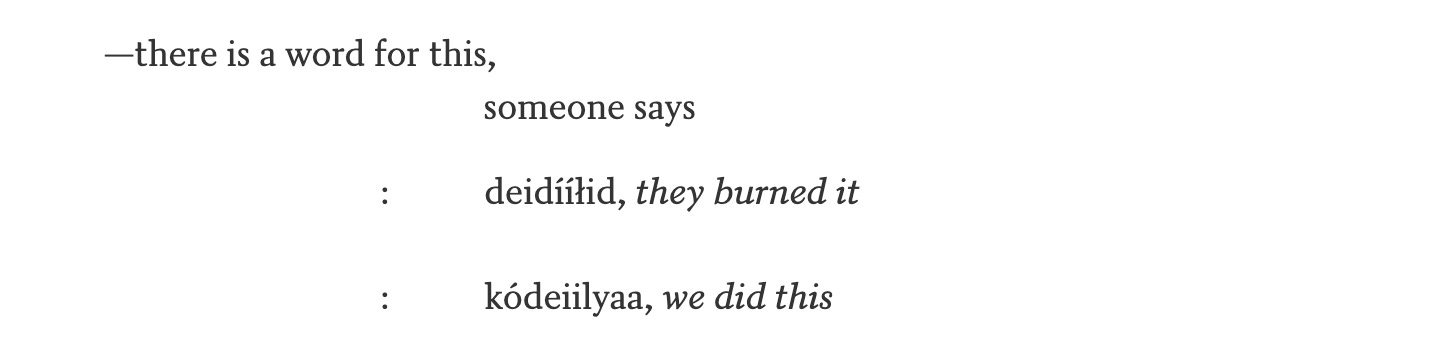
Here, the spacing presents us the closing lines almost as choices, which are further emphasized by the shift from third to first person:
“They burned it.”
“We did this.”
“They burned it. We did this.”
Additionally, the line breaks and the spacing of the colons create ambiguity around whether some unnamed speaker (“someone”) is saying the final two lines or if the poem’s speaker hears someone say “there is a word for this,” after which he provides the two that come most readily to mind (“deidííłid” and “kódeiilyaa”).
These sorts of interesting equivocations exist throughout the poem and provide a pervasive sense of uncertainty or a lack of words to describe what’s so painfully apparent in Skeets’ images.
By now, we hope you’re taking the chance to search out more of these slippery, intentionally vague spaces within the poem. As you do, you might consider two of the questions that came to mind for us while reading:
What is the effect of the undefined throughout the poem? Repeatedly Skeets leans on the vague “somewhere” and “someone.” In what ways does this vagueness shape and strengthen the poem?
At multiple points throughout the poem, it’s difficult to tell where a Diné-to-English translation ends. What are the implications of this ambiguity?
As always, if you stumble across something brilliant, or if you have a question that lingers with you, leave us a comment. We’d love to hear from you.
Classroom Context
“Anthropocene: A Dictionary” is a challenging poem, and we recommend utilizing it selectively. However, when used, it can be a powerful text for examining the effects of connotation on a poem’s mood and the relationships between language and culture.
We suggest easing students into the poem by first defining “Anthropocene,” then sharing a bit about the poem’s structure, before finally asking them to identify the mood within the poem’s images. (From here, you may explore a deeper discussion of the word choice that shapes the mood your students identify.) This often serves as a relatively straightforward on-ramp into conversations about theme. When we know the mood of the poem, and we see evidence of the natural world being harmed in multiple ways, what are we to make of the final lines? Additionally, how does the poet’s identity as an American Indian shape the meaning further, and how does his exploration of language speak to the idea of loss? These are big questions that provide students with ample space to explore.
We also suggest using the poem to talk about line breaks and spacing—form. You may guide students’ analyses by providing them with the ideas provided above, or you may simply ask them to generate a list of possible reasons for Skeets to format the poem as he has. (Brainstorming activities like this work well when students are given dry-erase markers to write ideas on their desks before a quick, informal gallery walk.) This type of conversation can lead to interesting discussions about the nature of poetry, and free verse in particular.
Regardless of how you use “Anthropocene: A Dictionary” in class, though, we highly recommend creating space for questions and uncertainty—for exploring the uncharted. This is a poem for aiming high and deep—for going boldly into the abyss.